The First Christmas
A reflection on family, fracture and becoming whole

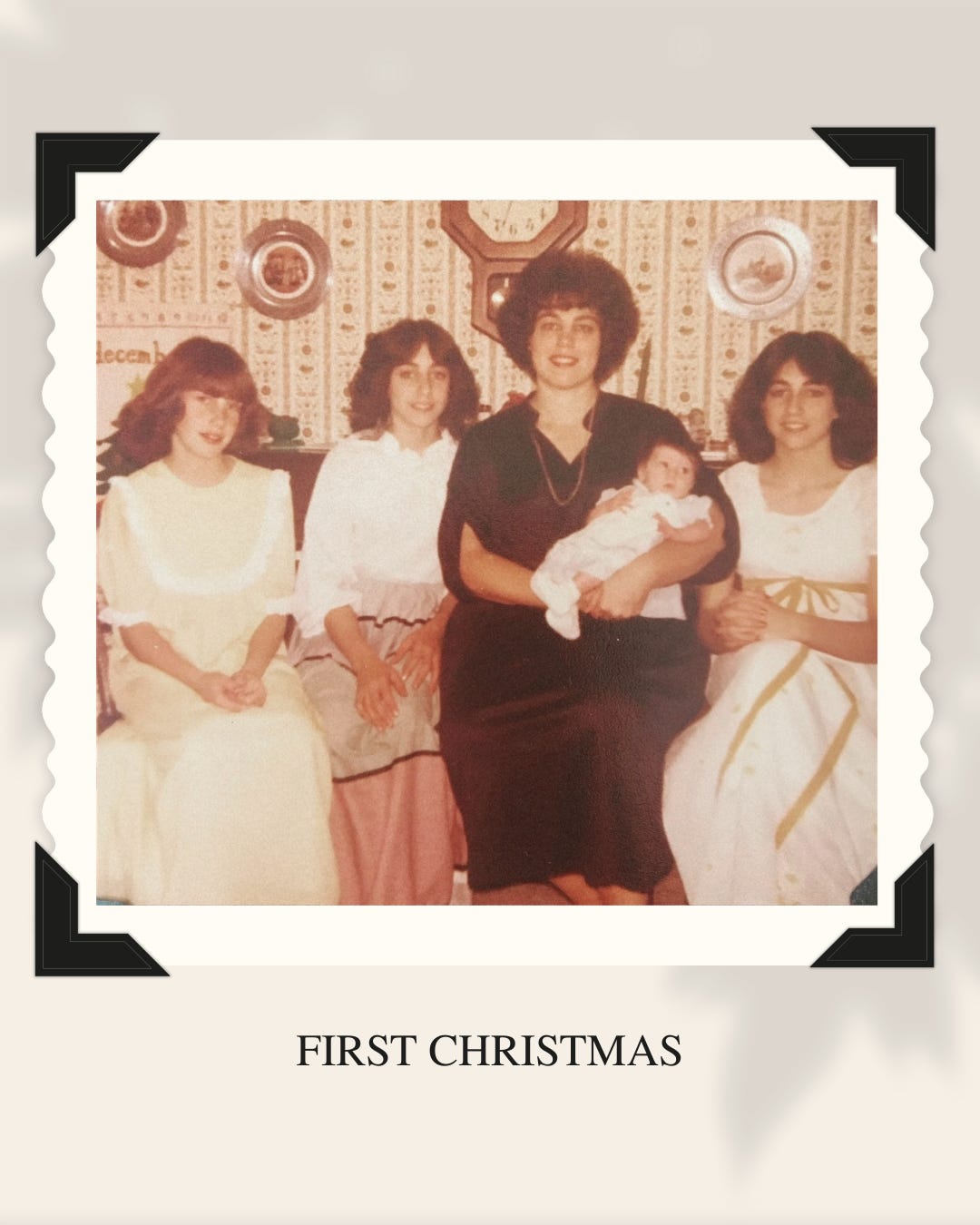
When I look at this photo from my first Christmas, the age difference is impossible to miss. I am a baby in my mom’s arms. My sisters are already so much older. I am the youngest of seven children, and most of my siblings are more than ten years older than me. The distance between us is visible before you know anything else about our family.
I did not grow up thinking my family failed me. That language never fit. What I felt instead was harder to name. There was love everywhere, people showed up and care was given. And still, there was a sense that something did not quite line up.
Only later did I understand it as a fracture. Not a break or an absence of love, but a strain that formed when too much was being asked of too few people.
Being the youngest in a family with such large age gaps creates a particular structure. When siblings are that much older, they do not just become siblings. They step into caretaking roles early. They fill in where a mother is stretched thin after raising many children before you. Love is present, but it is already divided.
That structure shaped how I grew up.
This photo brings up emotions that do not resolve easily. I feel thankful for what I was given and sadness for what never quite existed. There is also a strange humor in how obvious the contrast looks now. I never knew my sisters as little girls alongside me. I do not have memories of growing up together at the same pace or sharing the same developmental moments. There was no sense of all of us figuring life out together.
My memories are different. I remember being taken to college classes because someone had to watch me. I remember clothes being bought for me and advice being offered when I did not know what to do. I remember Christmas gifts chosen by my sisters when my mom did not have the time or the clarity to know what I wanted.
The sister on the far left in that photo gave me my first sex talk. She was the one I went to when all of my friends were getting boyfriends and becoming sexually active and I was scared and overwhelmed. She taught me how to put on makeup and what kinds of clothes felt like mine. She was who I turned to when I wanted my first real haircut. She was the person I told when boys sexually harassed me in sixth grade. She taught me about feminism and talked to me about contraceptives. She was also the sibling who took me wedding dress shopping. My mom was not present, and she did not show interest in being part of that moment. Without ever naming it, she became the primary maternal figure in my adolescence.
That care mattered and it shaped me. It also came at a cost that none of us chose.
I loved my sisters and still do. I was cared for by them. At the same time, I wanted something I could feel but not fully enter. They had a bond that existed before me. Sometimes they referred to themselves as the original five. That language stayed with me, even when it was not meant to hurt. I did not want to be someone they took care of… I wanted to be one of them.
Even as a child, I sensed that the care I received was not fully theirs to give. It came from responsibility rather than shared growing. It came from necessity rather than mutual dependence. That did not make it less loving, but it did make it complicated.
This is what I mean when I say my family did not fail. It fractured.
The fracture did not happen suddenly. It formed slowly as roles hardened. Over time, it became harder for me to move from being cared for into simply being a sibling. It also became harder for my sisters to step out of the maternal roles they had been asked to hold for so long.
Looking back, I think my mom may have felt the fracture first. Somewhere around my adolescence, it became clear that she did not know how to guide a teenage girl. It felt less like refusal and more like inability. There was an absence of guidance rooted in her own limits rather than a lack of care. Eventually, it seemed easier for her to let my sisters take over than to stay engaged herself.
That was when the distance deepened for me. It shifted from feeling unseen to feeling separate.
People often assume the youngest child is spoiled. That was not my experience. I experienced a different family system altogether. My parents were older. My siblings were more established. The family I grew up in was not the same one my sisters knew. Adolescence made that difference clearer. I could no longer be the small version of them. I had my own personality and my own way of being. As that became more visible, the maternal care I had relied on began to pull back.
When I return to that first Christmas photo now, I can see something I could not understand then. I belong with all the women in that picture, but I experienced each of them differently. Every one of them shaped me. Every one of them offered some form of care. Together, they make up my experience of being mothered.
Now I am a mother to a little girl. She does not have sisters, only a big brother. Becoming a full mother to her has helped me understand more clearly how much my sisters filled that role for me.
Recently, we talked about what it will be like when she gets her first period. What she can expect. As I was talking, the first person I thought of was my sister on the left in that photo. She was the one who had those conversations with me. The one who knew how to say things in a way that made my body feel less frightening and less wrong.
We talked about how my daughter can care for herself. About how she does not have to shrink when boys try to make her smaller. As I spoke, I felt myself standing fully in a role that once belonged to many people in my life.
I am able to show up this way in part because each of my sisters gave me a piece of that puzzle. Each one offered something that shaped how I understand care, guidance, and presence. Their mothering lives in me now, not as a replacement, but as something integrated.
This has helped me rewrite something deeper.
I belong in my family. I deserve to exist within it, not as the little child who needed to be managed, but as someone who is part of its history and its growth. My place was always there, even if it looked different. Even if it formed through shared care rather than shared childhood.
The fracture did not mean I was outside the family. It meant my belonging took another shape.
And now, as I mother my daughter, I can see it more clearly. I did not grow up outside love. I grew up inside it, held by many hands, learning how to gather those pieces and carry them forward.
Ahhh Kendyl, I have no words just admiration and I love this for you 💛